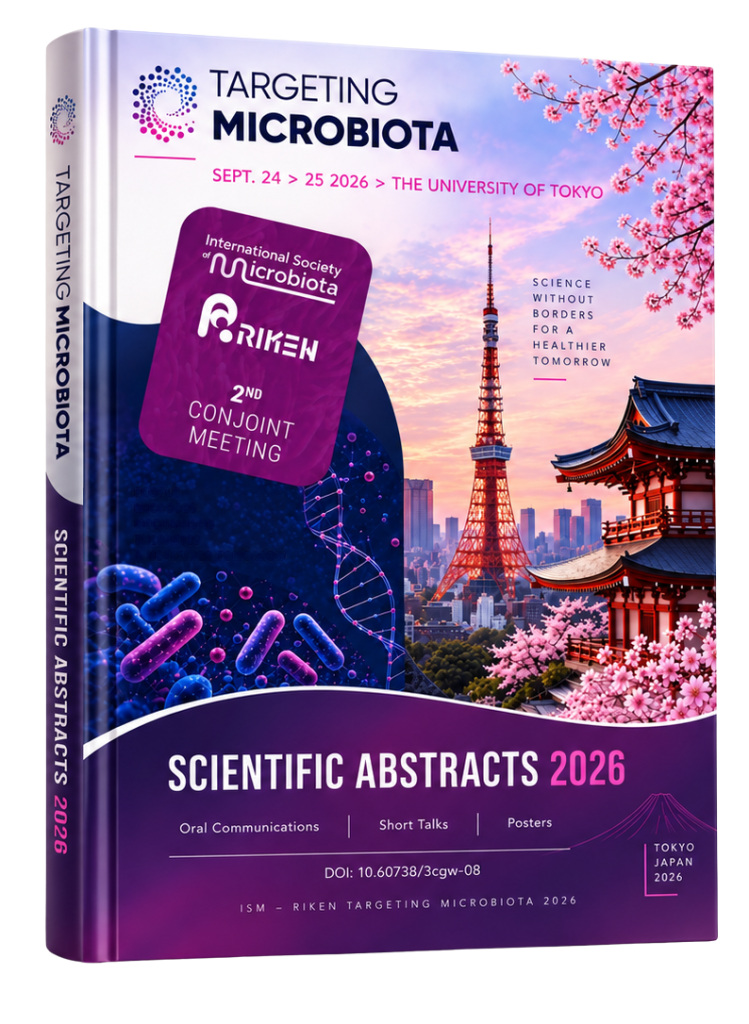
The Abstracts Book of ISM–RIKEN Targeting Microbiota 2026 is now available.


The Scientific Abstracts 2026 of the Second Conjoint RIKEN–ISM Targeting Microbiota Meeting are now ready.

81 pages of science, bringing together:

  • 18 major talks
  • 20 short communications
  • 28 posters

The Abstracts Book is available free of charge to all registered participants, both in person in Tokyo and online, as well as to all ISM members.

If you are not attending the meeting and would like immediate access before the event, the digital Abstracts Book is available for €95.

Access here: https://buy.stripe.com/14A5kD61v71s2jI9PE8bS0T

The DOI will be released publicly after the meeting.

This Abstracts Book provides a scientific record of the work and ideas that will be presented in Tokyo on September 24–25, 2026.

Targeting Microbiota 2026

The University of Tokyo
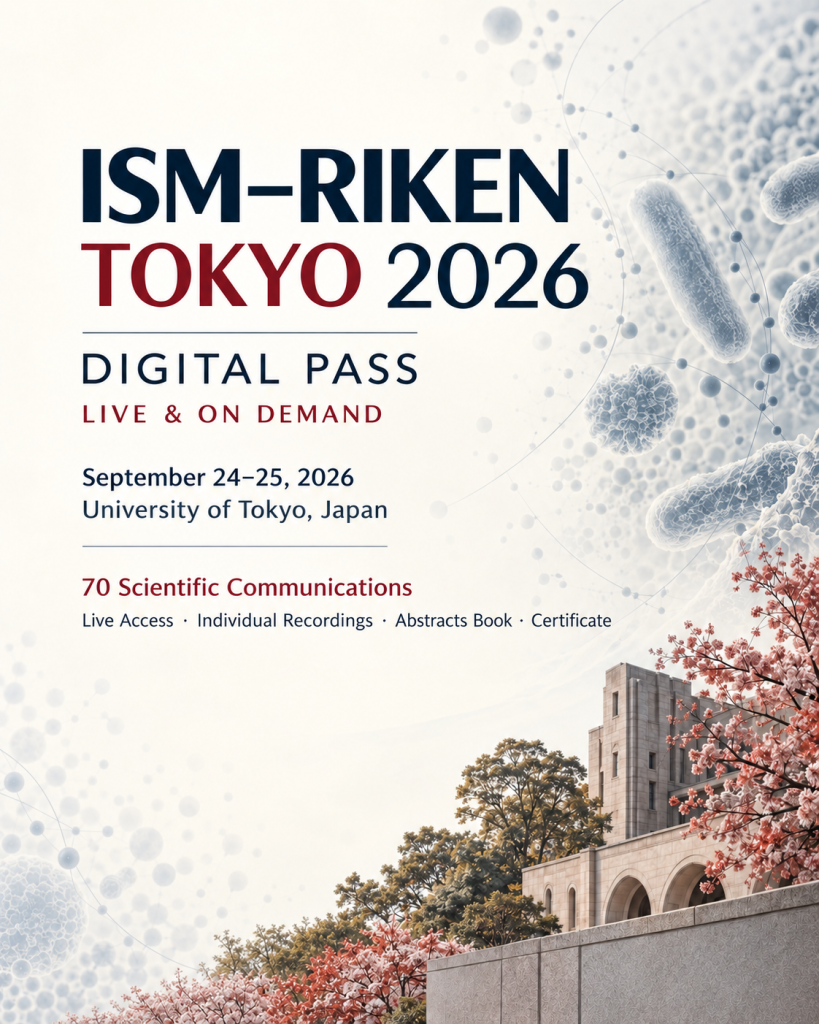
ISM–RIKEN Tokyo 2026 Digital Pass

Join Live or Watch On Demand

Join the ISM–RIKEN Meeting at The University of Tokyo from anywhere in the world – live on September 24–25, 2026, or later at your own pace.

Your Digital Pass gives you flexible access to the meeting and includes:

  • Live access to the two-day scientific meeting
  • Individual recordings of each speaker’s presentation
  • Three months of on-demand access
  • The official ISM–RIKEN Abstracts Book
  • Access to all accepted abstracts and scientific communications
  • The opportunity to submit questions to the speakers
  • Direct contact with speakers, subject to each speaker’s agreement and availability
  • An official ISM–RIKEN Certificate of Participation

Digital Pass Fees

  • Student/Researcher: €79 / ¥14,000
  • Academic/Clinician: €119 / ¥21,000
  • Industry Professional: €199 / ¥35,000

Digital Pass Registration is open. Click here to registration 

Discover two days of international microbiome science, distinguished speakers, and 70 scientific communications—wherever you are and whenever you choose.

Join live. Watch later. Connect with the speakers. Learn at your own pace.

September 24–25, 2026
The University of Tokyo, Japan

For more information:

Read the news on LinkedIn

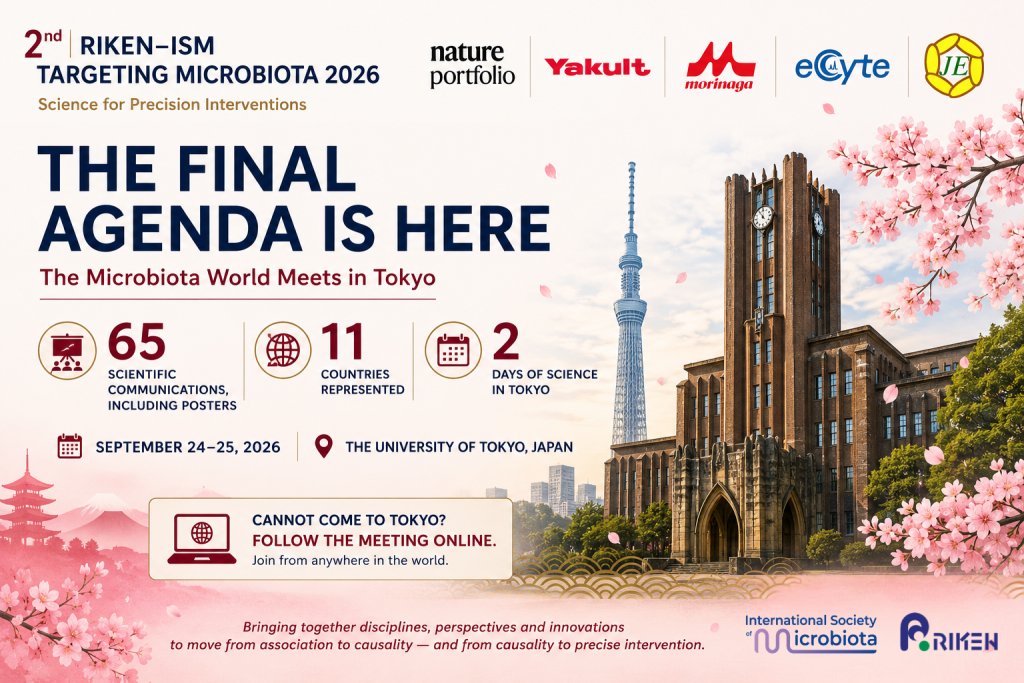
The Final Agenda Is Here: The Microbiota World Meets in Tokyo

65 Scientific Communications, 11 Countries and Two Days to Explore What Comes Next in Microbiota Science

The final scientific agenda of the 2nd RIKEN–ISM Targeting Microbiota 2026 is now available.

On September 24–25, 2026, scientists from Japan and around the world will gather at The University of Tokyo for two days of scientific exchange, with 65 scientific communications, including oral presentations and posters, representing 11 countries.

The program will explore some of the most rapidly evolving areas of microbiota research: host–microbiota interactions, microbial metabolites, immunity, mitochondria, single-cell and strain-level approaches, precision therapeutics and emerging innovations.

But beyond individual topics, one question will run throughout the meeting:

How do we move from association to causality — and from causality to precise intervention?

The Tokyo meeting is designed to connect disciplines that are too often considered separately and create dialogue between leading Japanese researchers and the international scientific community.

The final agenda also gives a strong place to emerging research and innovation, allowing new ideas and technologies to be discussed alongside established scientific leaders.

Cannot come to Tokyo?

The meeting can also be followed online, giving the international community the opportunity to join the discussions wherever they are.

September 24–25, 2026
The University of Tokyo, Japan

The final agenda is now available. Registration for onsite and online participation is open.

Final Agenda | Register Now

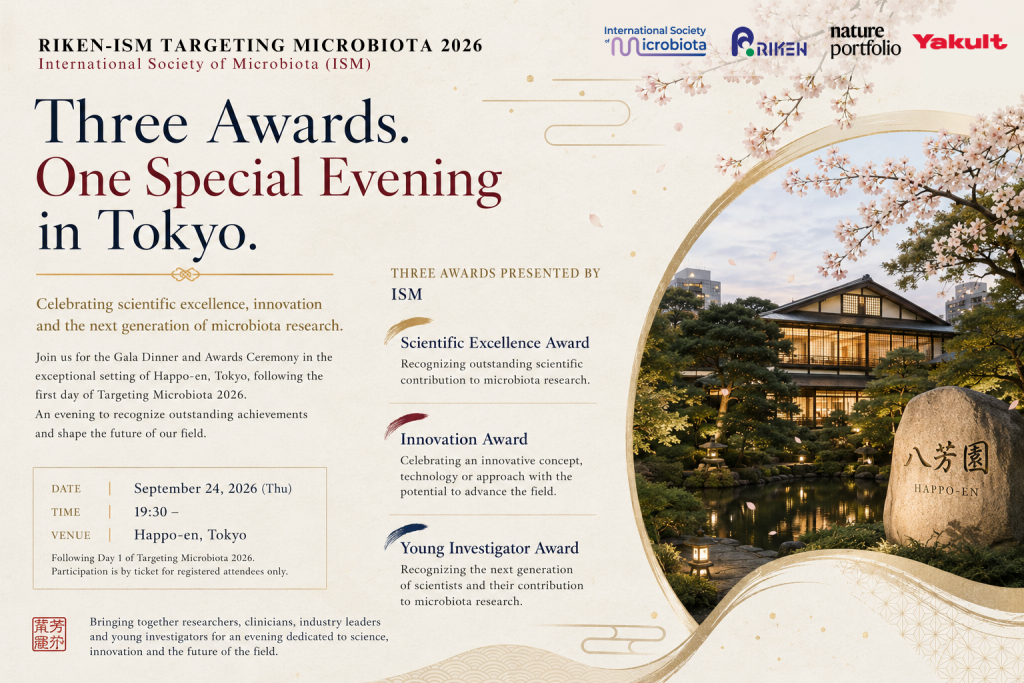
Three Awards. One Special Evening in Tokyo

RIKEN–ISM Targeting Microbiota 2026 will celebrate scientific excellence, innovation and the next generation of microbiota research at Happo-en.

On the evening of September 24, 2026, participants of Targeting Microbiota 2026 will gather at Happo-en, Tokyo, for the official Gala Dinner and Awards Ceremony.

In the unique setting of one of Tokyo’s historic Japanese gardens, the evening will recognize researchers and innovators contributing to the future of microbiota science and its translation into human health.

Three Awards will be presented by Nature Portfolio, Yakult & ISM:

Scientific Excellence Award

Recognizing outstanding scientific contribution to microbiota research.

Innovation Award

Celebrating an innovative concept, technology or approach with the potential to advance the field.

Young Investigator Award

Recognizing the next generation of scientists and their contribution to microbiota research.

The ceremony will bring together speakers, researchers, clinicians, industry leaders and young investigators for an evening dedicated to science, innovation and the future of the field.

September 24, 2026 | 19:30

Happo-en, Tokyo

Following Day 1 of the Second Co-joint RIKEN–ISM Targeting Microbiota 2026.

Register Now

For more information:

Read the news on LinkedIn

Nature Portfolio, Yakult and ISM Join Forces in Tokyo to Connect Global Funding with Japanese Microbiome Research

Nature Portfolio, Yakult and ISM Join Forces in Tokyo to Connect Global Funding with Japanese Microbiome Research

From Japanese Microbiome Science to Global Opportunity

A new opportunity is opening for the microbiome research community in Japan.

On 24–25 September 2026 at The University of Tokyo, ISM–RIKEN Targeting Microbiota will welcome the Global Grants for Gut Health (GGGH) programme, jointly supported by Nature Portfolio and Yakult.

GGGH has already supported more than USD 2.5 million in microbiome research and awards three research grants of USD 100,000 each year.

In Tokyo, the programme will be presented directly to Japanese and international researchers, with a dedicated presentation explaining its objectives, impact and application process.

How can Japanese microbiome research connect more strongly with global funding?

The discussion will bring together Hiroshi Ohno, RIKEN Center for Integrative Medical Sciences; Kiyoshi Takeda, Osaka University; Reiko Shinkura, The University of Tokyo; and Yumi Matsuoka, Osaka University, together with Jeffrey Robens from Nature Portfolio.

They will be joined by Marvin Edeas, Founder and Chairman of ISM, to explore how Japanese researchers can engage more effectively with international funding opportunities.

Three Best Abstract Prizes in Tokyo: JPY 100,000 each

The collaboration also introduces: Three Global Grants for Gut Health Best Abstract Prizes 

The recipients will be selected by the conference scientific and organising committees, keeping scientific excellence and independence at the heart of the awards.

Beyond funding, ISM–RIKEN Tokyo will bring together leading Japanese and international scientists for two days spanning host–microbiota interactions, microbial metabolites, gut–brain and gut–lung communication, single-cell and strain-level approaches, precision therapeutics and emerging microbiome technologies.

The objective is clear: to create stronger connections between Japanese scientific excellence, international collaboration and new opportunities for the next generation of microbiome researchers.

Join us at:

ISM–RIKEN Targeting Microbiota 2026

24–25 September 2026 | The University of Tokyo, Japan

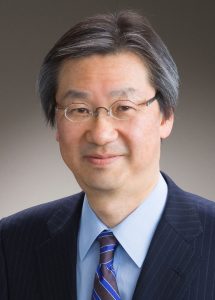
RIKEN Center Director Prof. Masayuki Amagai to Open the 2nd Joint RIKEN–ISM Targeting Microbiota 2026

The Director of the RIKEN Center for Integrative Medical Sciences will officially launch the international meeting in Tokyo.

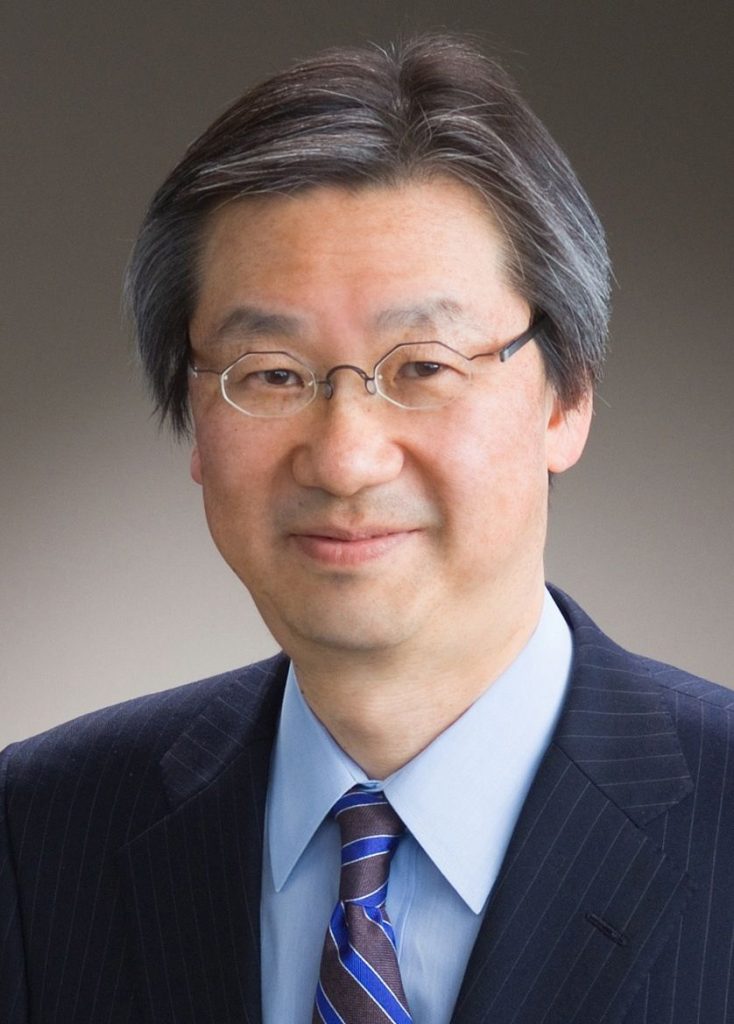
Tokyo, Japan — September 1, 2026 — Prof. Masayuki Amagai, MD, PhD, Director of the RIKEN Center for Integrative Medical Sciences and Professor of Dermatology at Keio University School of Medicine, will deliver the opening remarks at the 2nd Joint RIKEN–ISM Targeting Microbiota 2026, taking place on September 24–25, 2026, at The University of Tokyo.

Internationally recognized for his work in skin immunology and barrier biology, Prof. Amagai brings exceptional scientific and institutional leadership to a meeting exploring one of medicine’s most dynamic frontiers: how the microbiota shapes immunity, inflammation and human health.

His presence also highlights RIKEN’s commitment to advancing integrative medical science and strengthening international collaboration in microbiota research.

Prof. Amagai’s remarks will formally open two days of scientific exchange bringing together leading researchers, clinicians and innovators to examine host–microbiota interactions, microbial metabolites, barrier function and the next generation of microbiota-based therapies.

Event: 2nd Joint RIKEN–ISM Targeting Microbiota 2026

Dates: September 24–25, 2026

Venue: The University of Tokyo, Japan

Website: tokyo.microbiota-ism.com

For more information:

Read the news on LinkedIn

Is Your Innovation Ready to Shape the Future of Microbiome Medicine?

The microbiome field does not need another promising concept.

It needs technologies, products, platforms, and solutions capable of moving microbiome science toward real clinical and industrial impact.

At RIKEN–ISM Tokyo 2026, a dedicated Innovation Session will give companies, startups, biotech developers, and academic innovators the opportunity to present their latest advances to an international audience of scientists, clinicians, investors, and industry leaders.

We are looking for innovations in microbiome therapeutics, diagnostics, precision nutrition, AI, microbial metabolites, probiotics, postbiotics, phage technologies, fermentation, analytical platforms, and enabling technologies.

Selected projects will be presented at The University of Tokyo on September 24–25, 2026.

As in the previous edition, an ISM Award for Best Innovation will be presented to the most promising and impactful innovation.

Do not simply attend the future of microbiome medicine. Present the innovation that could define it.

Submit Your Innovation

Companies, startups, technology developers, and research teams are invited to apply.

tokyo[at]microbiota-ism.com

The University of Tokyo will host the Second Conjoint RIKEN – ISM 2026 Meeting

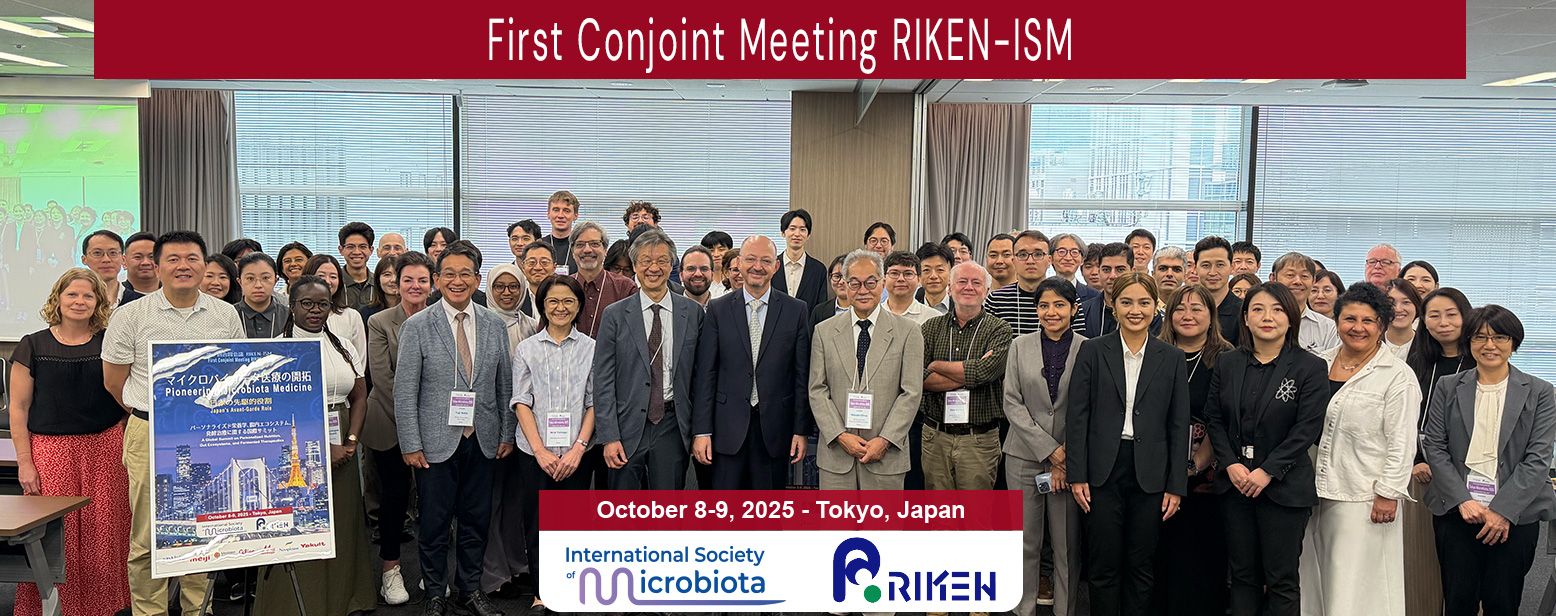
The University of Tokyo will serve as host city for the Second Conjoint Meeting between the International Society of Microbiota (ISM) and RIKEN, scheduled for September 24–25, 2026. Building on the momentum of the inaugural RIKEN-ISM meeting, which drew researchers, clinicians, and innovators from dozens of countries, this second edition promises to be an even broader and more impactful gathering for the global microbiome community.

At the heart of the meeting is its unique ability to unite scientists across disciplines. By bridging fundamental biology, clinical research, nutrition, biotechnology, and innovation, the event aims to forge a shared scientific language around microbial ecosystems and their role in human health. Researchers working at the bench will sit alongside clinicians, industry scientists, and entrepreneurs, a combination organisers believe is essential to accelerating progress in microbiome medicine.

What’s on the Programme?

The 2026 scientific programme will spotlight some of the most pressing frontiers in microbiota research. Key themes include host–microbiota interactions, microbial metabolites as mediators of host health, precision probiotics, and the emerging field of microbiome medicine. A dedicated focus will also be placed on the contribution of microbiota science to healthy aging, a topic of growing urgency worldwide.

Japan’s own scientific heritage adds a distinctive layer to the programme. The meeting will spotlight the country’s centuries-old expertise in fermentation science, its leading role in probiotic strain discovery, and its vibrant culture of microbial innovation, a fitting backdrop for an event of this calibre.

RIKEN and ISM have stated their ambition to make the meeting not only scientifically rigorous but also original and impactful, fostering genuine dialogue, new collaborations, and fresh perspectives on the microbiome’s role in medicine and beyond. Registration and further details are expected to be announced through the official ISM and RIKEN channels in the coming months.

Source: International Society of Microbiota — Second Conjoint Meeting ISM-RIKEN

Tokyo Microbiota 2025 Recognizes Excellence in Science, Health Impact, and Innovation

Tokyo Microbiota 2025 celebrated outstanding contributions to microbiota research through its Scientific Awards, Healthy Impact Awards, and Innovation Awards, highlighting progress from fundamental science to clinical and industrial innovation.

Scientific Awards
The Scientific Awards honored academic excellence and scientific rigor across diverse areas of microbiota research, including host–microbe interactions, immune regulation, metabolism, and translational microbiology:
• Hiroshi Ohno (RIKEN), for pioneering work in mucosal immunology and host–microbiota interactions
• Naoko Ohtani (Osaka Metropolitan University), for innovative studies linking microbiota function to metabolic and physiological regulation
• Kiyoshi Takeda (Osaka University), for mechanistic insights into immune–microbiota crosstalk
• Alain Stinzi (University of Ottawa), for advancing translational and comparative microbiota research
• Masayuki Amagai (RIKEN & Keio University School of Medicine), for bridging fundamental microbiology with clinical investigation

Healthy Impact Awards
The Healthy Impact Awards recognized initiatives with clear relevance to human health and clinical application:
• Metagen Therapeutics, represented by Hikaru Watanabe, for microbiota-based therapeutic development
• Meiji, for long-standing contributions to nutrition and gut health research
• Sethic, represented by Kim Jing, for clinically oriented microbiota solutions
• Metabiogenix, represented by Mario Acosta, for translational approaches in microbiome medicine
• Glico, for innovation in glycobiology and microbiota-related health applications

Innovation Awards
The Innovation Awards highlighted companies driving applied innovation in microbiota science and related technologies:
• Morinaga, represented by Akari Hiraku, for innovation in functional foods and microbiota-supporting nutrition
• Yakult, represented by Osamu Chonan, for leadership in probiotic research and consumer health applications
• Freda, represented by Yang Su-Zhen, for developing microbiota-informed health products
• Ninapharm, represented by Sawako Hibino, for collaborative innovation in microbiota-based therapeutic development

Together, these awards reflect the strength of the microbiota ecosystem showcased in Tokyo, emphasizing scientific excellence, health impact, and innovation across academia and industry.

Tokyo Microbiota 2025 Concluding Remarks: Advancing Microbiota Research into Medicine – Japan’s Contributions to Mechanism, Translation, and Clinical Impact

Over the course of this meeting, one message has emerged with clarity: microbiota research in Japan has reached a level of scientific maturity characterized by mechanistic depth and growing clinical relevance. The work presented here reflects not only technical excellence, but also a sustained effort to connect fundamental microbiology with medical application.

Japanese research groups have shown strong leadership in moving beyond descriptive microbiome studies toward functional and causal understanding. Across sessions, investigators addressed how microbial communities influence host metabolism, immune regulation, ageing, and disease susceptibility, using integrated strategies that combine multi-omics technologies, experimental models, and well-characterized human cohorts. This mechanistic focus represents a critical step for the field.

A defining feature of this meeting has been its clinical orientation. Several contributions focused on patient-centered research, including longitudinal cohort studies, interventional trials, and the identification of microbiota-derived biomarkers. These approaches illustrate how microbial functions and metabolites are increasingly evaluated not only as biological readouts, but as tools for diagnosis, risk stratification, and therapeutic development.

Japan’s long-standing expertise in microbial science, nutrition, and fermentation provides a strong foundation for these advances. What is particularly evident is how this foundation is being translated into contemporary clinical frameworks, including precision medicine and preventive healthcare. Productive interactions between academic research, clinical practice, and industry have been a recurring theme throughout the program.

At the same time, discussions have highlighted challenges that will shape the next phase of microbiota-based medicine, including standardization, reproducibility, population-specific variability, and regulatory considerations. Addressing these issues will require sustained interdisciplinary collaboration and coordinated international efforts.

In conclusion, this meeting has provided a clear view of the current state and future direction of microbiota science. The contributions presented here underscore Japan’s central role in advancing microbiota research into medicine, with implications extending to global clinical practice. We thank RIKEN and the International Society of Microbiota (ISM) for this excellent initiative, which has successfully built a bridge between Japanese scientific leadership and the international microbiota community, enabling meaningful exchange and future collaboration.