
Single-Cell Visualization and Australia’s Human Microbiome Biobank: New Tools for Strain-Level Microbiome Science
Gene Tyson, Queensland University of Technology, Australia
We are pleased to announce that Dr. Wataru Suda from RIKEN Center for Integrative Medical Sciences (IMS), Japan will join Second Conjoint RIKEN – ISM 2026 as a speaker and give a presentation entitled Single-Cell Visualization and Australia’s Human Microbiome Biobank: New Tools for Strain-Level Microbiome Science.
Prof. Gene Tyson, Director of the Center for Microbiome Research at Queensland University of Technology and Director of the Australian Human Microbiome Biobank, will discuss how strain-level resolution and mechanistic study of uncultured species can be achieved through an integrated platform that combines national-scale biobanking with single-cell visualization.
Most species detected in human-associated microbiomes have never been cultured, restricting functional work to computational inference, while sequencing-based methods recover compositional information but cannot localize individual strains or mobile genetic elements within complex communities. Prof. Tyson’s laboratory has developed two complementary tools to address these challenges in tandem.
During his talk, he will present the Australian Human Microbiome Biobank (AHMB), a national research infrastructure housing over 25,000 authenticated, whole-genome sequenced microbial isolates from the human gut, skin, oral, and vaginal microbiomes, approximately 38% of which represent previously uncultured species, supported by a high-throughput anaerobic cultivation platform integrating spectral flow cytometry and metagenomics. He will then introduce GenomeFISH, a genome-based fluorescence in situ hybridization approach that achieves strain-level resolution at up to 99% average nucleotide identity. Extensions of this method, PlasmidFISH and VirusFISH, enable in situ localization of plasmids and bacteriophages within their host cells. This presentation provides the enabling technologies required to move from taxonomic cataloging to strain-resolved, mechanistic understanding of the human microbiome, a prerequisite for precision microbiota-based interventions.
For more information about his talk:
News on LinkedIn
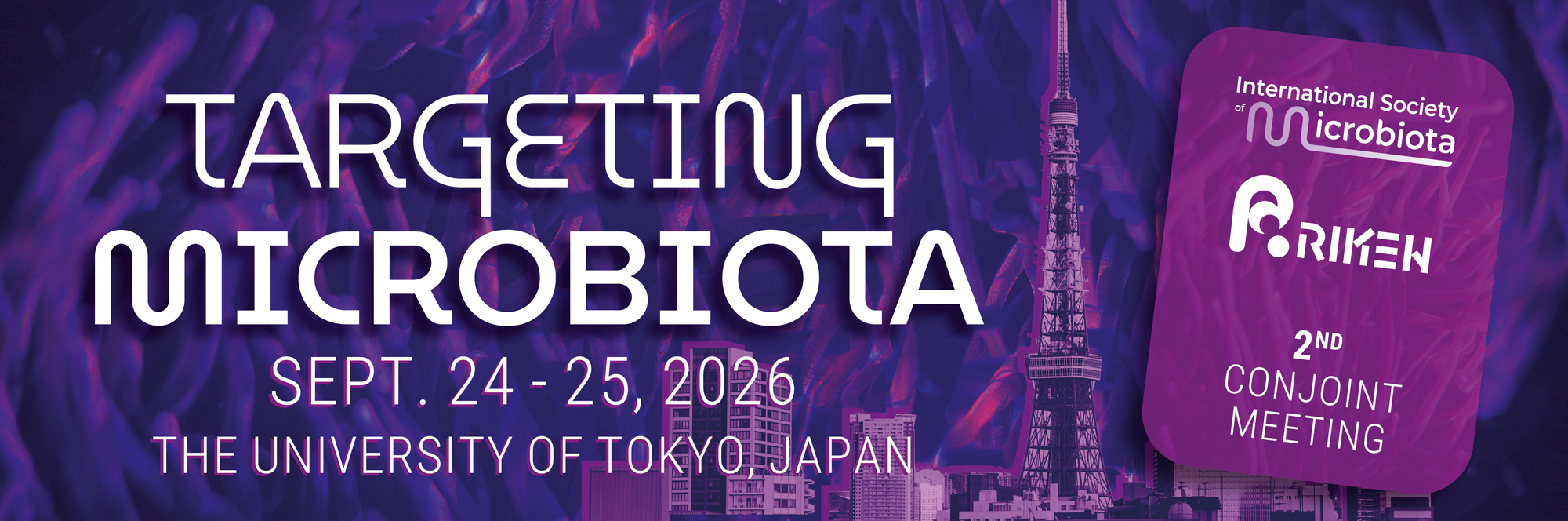
The 2nd RIKEN-ISM Conjoint Meeting
Tokyo Microbiota 2026
September 24-25, 2026 – The University of Tokyo, Japan
tokyo.microbiota-ism.com